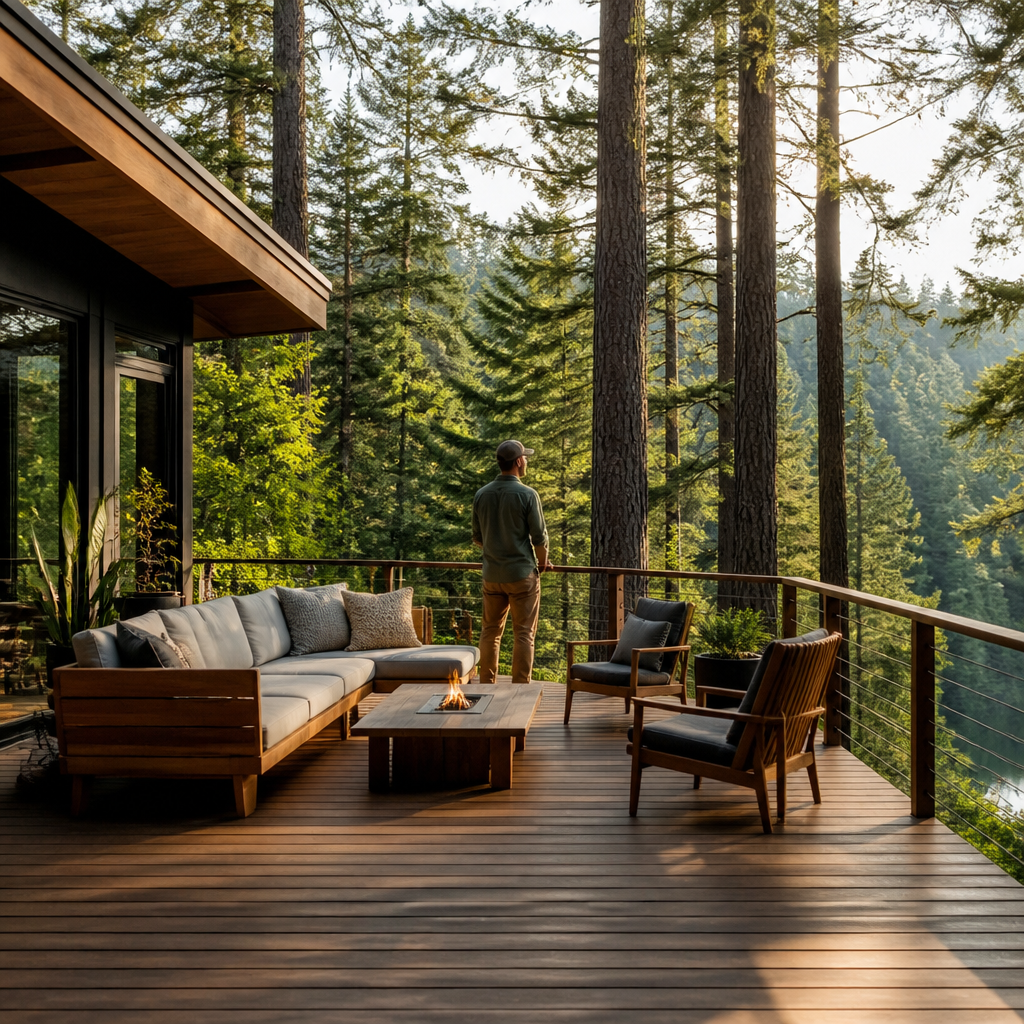
Gareth has run a small landscaping firm on the outskirts of Manchester for almost twenty years. For most of that time, his garden projects used softwood decking, because it was cheap, familiar and easy to cut on site. Then the call-backs started piling up. Boards that had looked handsome in June were grey and furry by the following spring, a few had warped badly, and one client sent him a photo of a splinter the size of a matchstick lodged in her toddler’s foot. That photo stayed with him. Within a year, almost every deck he built was composite, and choosing where to buy it became one of the most important decisions in his business.
Table of Contents
ToggleWhat WPC Actually Is
WPC stands for wood-plastic composite. As the name suggests, it blends wood fibre with plastic and a small proportion of additives, then extrudes the mix into boards that look like timber but behave rather differently. Kreco, a manufacturer based in Xuancheng in China’s Anhui Province, describes its decking as using UV inhibitors and stabilisers to limit fading, and its fencing page says the material is made from recycled materials and is 100% recyclable.
For homeowners, the appeal is mostly practical. Composite doesn’t need staining or varnishing every summer, it doesn’t rot like untreated timber and it won’t throw up splinters. For anyone who cares about the environment, the use of recycled wood fibre and plastic is an extra point in its favour, although the details vary from one manufacturer to the next. Fewer tins of stain and varnish over the years also means fewer chemicals washing into garden soil, which matters to a growing number of homeowners.
Why the Manufacturer Matters So Much
Not all composite is made equally. Board density, the quality of the surface layer, colour stability and the consistency of each batch can all differ widely between suppliers. Gareth learnt this the slightly expensive way, when an early order from a trader arrived in two noticeably different shades of grey. The client was polite about it. Gareth wasn’t.
Buying closer to the source tends to give more control. Kreco presents itself as a factory rather than a middleman, and lists ISO 9001, CE and FSC among its certifications. It also mentions customisation of colour, texture, size and packaging, with a stated minimum order of 200 square metres for decking and fencing and a lead time of 15 to 30 days. For a builder planning a season’s worth of projects, those details matter far more than a glossy brochure.
Decking Is Only the Start
Many garden makeovers grow beyond the deck itself. Once a client sees how tidy a composite deck looks, the tired fence behind it and the patchy rendered wall of the garden office suddenly seem a lot less acceptable. Matching materials across a whole outdoor space can make even a small garden feel deliberately designed.
Cladding for Walls and Garden Rooms
Composite cladding has become a popular way to refresh garden rooms, extensions and feature walls. Builders comparing composite cladding manufacturers will find that Kreco lists several styles, including co-extrusion slat panels, 2D and 3D embossed boards, grooved boards and slat wall panelling. Its page notes that the product needs no painting or glue and mentions matching fasteners, clips and trim. Warranties are given by type, with 15 years for 2D wood grain, 20 years for 3D embossed and 25 years for co-extrusion.
Gareth’s favourite job last year was a garden office in Stockport clad in charcoal slats. The owner works from it every weekday and says it’s the first room she’s had that nobody else in the family dares to colonise.
Fencing That Lasts
Fences take a battering in the British weather. Timber panels lean, rot at the base and need treating every year or two, which is a chore most people quietly abandon. For anyone looking at a composite wood fence, Kreco’s range includes slat panels, 2D wood grain and 3D embossed panels, grooved boards and semi-privacy screens, along with posts, caps and rails. The company describes the material as weatherproof and resistant to decay, splitting and warping, and suggests cleaning with a soft brush, soap and water at least twice a year.
Installation is described as simple enough for keen DIYers, though the page sensibly reminds buyers to check local permit rules on fence height. Gareth still prefers to set posts in concrete himself. Old habits, he says, are cheaper than call-backs.
Questions Worth Asking Any Manufacturer
Choosing a supplier isn’t only about price. A few questions tend to separate dependable manufacturers from the rest:
- Which certifications apply to the specific product being ordered?
- What does the warranty cover, and for how long, on each product type?
- Can samples be sent before a large order, so colour and texture can be checked in daylight?
- How is the material packed for shipping, and what happens if boards arrive damaged?
- Are matching trims, clips and fixings available, so the finished job looks consistent?
Gareth now refuses to place an order without first leaving samples outside for a fortnight. He says the British weather does a more honest review than any website.
Living With Composite
Composite isn’t completely maintenance-free, whatever the marketing sometimes implies. Leaves left in damp piles can stain, barbecue grease needs wiping up, and boards can get hot in strong sun, especially darker shades. A gentle wash in spring and autumn keeps most decks and fences looking fresh. It’s a far cry from sanding and staining, but it still needs a bit of attention.
It’s also worth thinking about colour with the house in mind. A warm brown can soften a red-brick home, while cooler greys tend to suit modern rendered walls. Bringing a photo of the house when choosing samples sounds obvious. Surprisingly few people do it.
Final Thoughts
Choosing a WPC composite decking manufacturer shapes everything that follows, from how a deck looks in its first summer to how it’s holding up ten years later. Certifications, warranties, sample quality and the ability to supply matching cladding and fencing all deserve as much attention as price. Gareth hasn’t had a splinter photo in years. His clients now send him pictures of barbecues instead, which he much prefers.